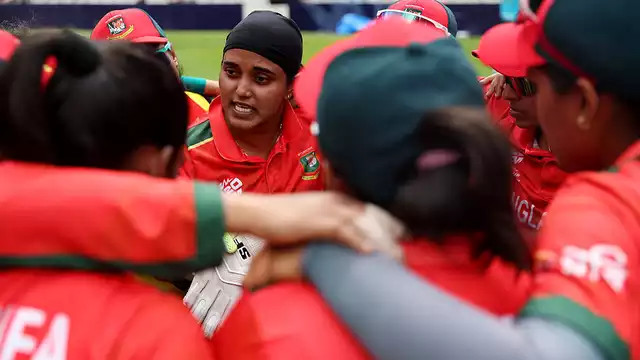
Bangladesh Women’s head coach Sarowar Imran has sparked a significant rift with the Bangladesh Cricket Board (BCB) following his public comments regarding internal unrest during the 2026 Asian Games. The coach suggested that uncertainty over his tenure and the leadership status of captain Nigar Sultana negatively impacted the team’s performance, ultimately contributing to their exit from the tournament in Japan.
Nigar Sultana recently stepped down as T20I captain, stating her desire to focus on her personal game. While she avoided public controversy, Imran alleged that the team environment deteriorated midway through the Asia Cup. He argued that rumors regarding coaching changes and captaincy security created a distracting atmosphere that hindered the players’ ability to perform, manifesting in poor scoring totals against teams like the UAE and Indonesia.
Imran, who led Bangladesh in their inaugural Test match against India in 2000, claimed that players felt sidelined by ongoing media speculation during tournament play. He stated that because these reports surfaced while the team was active, they undermined the group’s focus. He noted that his own two-year contract is set to conclude this October, suggesting that he had no personal expectations regarding his future with the national side.
The BCB has responded sharply to these remarks, with director Rafiq Ahmed confirming that the board plans to issue a show-cause notice to the coach. Rafiq rejected the claims of instability, insisting that the board provided consistent support, including increased match fees and upgraded travel arrangements. He maintained that no discussions regarding a change in captaincy ever took place among the directors.
According to the board, Nigar resigned without consulting official leadership, which Rafiq described as a missed opportunity for accountability. He expressed frustration at the suggestion that the board had created a hostile environment, labeling the coach’s comments as dishonest. The board clarified that it had not officially discussed the future of the coaching staff with Imran during the ongoing tournament.
Beyond the immediate team disputes, Imran highlighted systemic challenges facing women’s cricket in Bangladesh. He pointed to a lack of foundational infrastructure, specifically the absence of school-level competition and dedicated age-group programs. He contrasted this with Sri Lanka, where a robust network of girls’ school cricket exists, providing a pipeline of talent that is currently missing in Bangladesh.
Imran emphasized that the sport requires structural investment, such as the creation of Under-18 setups and specialized training facilities, to remain competitive with regional rivals like India, Pakistan, and Sri Lanka. He noted that currently, finding enough players to fill a national squad remains a struggle, with a total pool of roughly 30 players available.
Despite the current friction, Imran acknowledged that positive steps have been taken under the leadership of Nasiruddin Faruque to treat the women’s team with parity to the men’s side. He suggested that if these initiatives—including High Performance camps and school cricket—are sustained, the team could reach a competitive level within a year.
Internal developments appear to be moving toward a coaching overhaul regardless of the current dispute. Sources indicate that David Hemp is the primary candidate to succeed Imran as head coach. Reports also suggest that Nasiruddin Faruque, the current batting coach, may be replaced as part of a wider administrative restructuring of the coaching department.
The situation highlights a widening gap between the team’s management and board expectations. While Imran views the lack of clarity as a failure of leadership that impacted results, the BCB views his public comments as a breach of conduct that warrants a formal inquiry.
As the team returns home from the Asian Games empty-handed, both parties are expected to engage in further discussions regarding the future direction of the women’s cricket program. The formal show-cause process will likely serve as the next step in resolving the standoff between the coach and the board. The report also notes that everything has suddenly shifted,” Imran, who guided Bangladesh in the inaugural Test match against India in 2000, told reporters after the game. The report also notes that various kinds of reports and rumors have been coming out from different places… to the point that we couldn’t even score 120-130 against teams like Indonesia and the UAE, ever since that loss. The report also notes that and we are still carrying that exact slump into the Asian Games,” he said. The report also notes that “You know who holds the primary responsibility (of our failure) better than I do. The report also notes that however you want to frame it… you’re asking me. The report also notes that we played in World Cups under entirely different circumstances. The report also notes that “Our problem actually started back in the Asia Cup. The report also notes that “That kind of thing (negative report) can impact the team and the players.