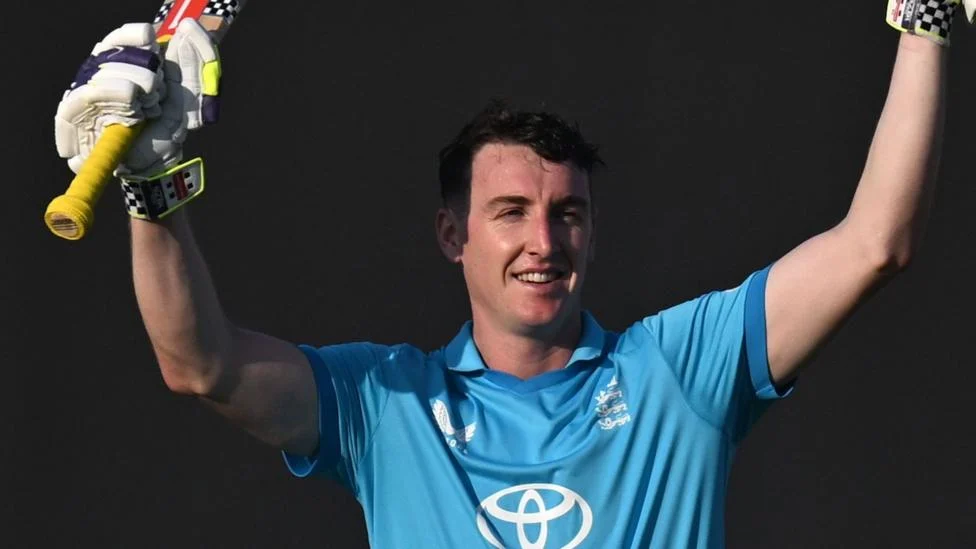
Harry Brook produced a historic individual display in Rawalpindi, smashing a 114-ball double century to register the fastest 200 in the history of one-day internationals. His extraordinary knock of 202 against Sri Lanka included 21 boundaries and 10 sixes, eclipsing the previous fastest ODI double ton of 117 balls set by India’s Shubman Gill against the West Indies last month. Brook also surpassed Ben Stokes’s 182 against New Zealand in 2023 to record the highest individual ODI score by an Englishman, becoming the first player from his country to reach 200 in the format.
Despite Brook’s stroke-making marvels, which drew comparisons to South Africa’s AB de Villiers, England suffered a dramatic collapse. Sri Lanka successfully completed the second-highest run-chase in ODI history, overtaking England’s massive total after the English team failed to defend a 430-run target. In doing so, Brook became the first batter in ODI history to score a double century and end up on the losing side. Brook probably does not get enough credit for making such a decision. Against Sri Lanka, England somehow lost from what seemed an impregnable position, their bowling and fielding falling apart amid a growing realisation they were in danger of failing to defend a target of 430.
With this landmark performance, Brook achieved a rare international treble, matching West Indies legend Chris Gayle as the only players to score a Test triple century, an ODI double century, and a T20 international hundred. The accomplishment marks a remarkable 12-month turnaround for the captain, who faced questions over his future and white-ball leadership following a dismal performance in Wellington a year ago. The collection of another landmark might not mean a great deal to Brook, in the moment. Perhaps only Australia’s Travis Head can challenge Brook for the crown. What a turnaround in 12 months.
Brook’s record-setting feat reinforces his standing as one of cricket’s premier all-format batters.
ICC rankings currently place him as the world’s top Test batter, supported by a 53.08 average. No England player with at least 20 innings since 1968 boasts a higher Test average, placing him ahead of legendary figures such as Joe Root, Alastair Cook, Geoffrey Boycott, and Graham Gooch. Former teammates and legends have echoed this standing, with Ben Stokes remarking that Brook possesses more talent than Kevin Pietersen, while James Anderson suggested Brook could eventually overtake Root as England’s leading Test run-scorer. There can be no higher praise than to compare Brook’s dismantling of the Sri Lankan attack to the sort of innings once played by South African genius AB de Villiers. The responsibility of captaincy suits him. There is the question of how good Brook could become. According to in 2024, James Anderson, Brook could surpass Root as England’s highest Test run-scorer. In terms of improvement, Brook has already shown a willingness to do the hard yards to become a better cricketer. Well-qualified judges don’t hold back in their praise, as for the batting. There is the chance to play a major part in regaining the urn and to become one of the few British athletes to lift a World Cup in any sport.
His white-ball record is equally formidable. In T20 internationals, Brook averages 36.21 with a strike rate of 164.92, setting the benchmark for players with 20 or more innings for major cricketing nations. Although his List A career remains relatively short with just 61 matches—45 of which have come in ODIs—his 50-over form has surged. Over his last 29 ODIs, Brook averages nearly 50, and his 2026 average stands at almost 57. Leadership has elevated his figures further, with his ODI average rising by 31 runs as captain, while his T20 average increases by 19 runs when leading the side. For a man who has previously spoken about prioritising match-winning contributions over individual achievements, Brook the captain was left dejected that his innings ultimately counted for nothing. In T20s, his average jumps 19 runs when wearing the metaphorical armband.
These figures come despite a relentless schedule. Brook has featured in every England match since resting during a T20 series in Ireland last September. Barring injuries, he will be the only squad member to play throughout the entire winter campaign, covering five tours across four countries and three continents without returning home until mid-January. To manage his workload and prioritize national duties, Brook opted out of the lucrative Indian Premier League, using that window for rest instead.
Even with his impressive resume, Brook has noted that he remains a work in progress. Speaking in August, he acknowledged needing to adapt quicker during matches despite his ability to score all around the ground. While Stokes urged him after the Ashes to target a Test average above 60, Brook has steadily refined his game, transforming from an athletically challenged youngster into one of England’s fittest players, best runners between the wickets, and most dependable outfield catchers. Speaking to in August, Brook admitted to not being the “finished article”.
The main element missing from Brook’s career remains a defining hero role in a major series or tournament triumph. He played a minor role in England’s 2022 T20 World Cup victory, was unable to register a century across 10 Ashes Tests, and famously lost his wicket late on during the fifth Test against India at The Oval last year when victory was within reach. However, prime opportunities await as Brook approaches his peak at age 28, with a home Ashes series scheduled for next summer followed by the 50-over World Cup in southern Africa.
For now, Brook and England face immediate operational problems in their ongoing tri-series in Pakistan. After dropping catches and playing poor shots in an opening loss to the hosts, England’s bowling and fielding unravelled against Sri Lanka. Heavy dew created slippery conditions, while key bowlers Jofra Archer and Adil Rashid were unavailable due to rest and squad rotation.
England’s bowling attack struggled immensely, highlighted by Sam Curran recording the worst figures by an England bowler in ODI history after conceding 103 runs from nine overs. Tactical decisions also backfired as Brook continued with the left-arm seamer instead of utilizing the full 10-over quotas of Josh Tongue or Gus Atkinson.
Following two consecutive defeats, England must win their remaining two group matches to qualify for the tri-series final on October 31. For Brook, guiding his team through the group stage offers a chance to rectify tactical errors and build momentum ahead of upcoming major campaigns.