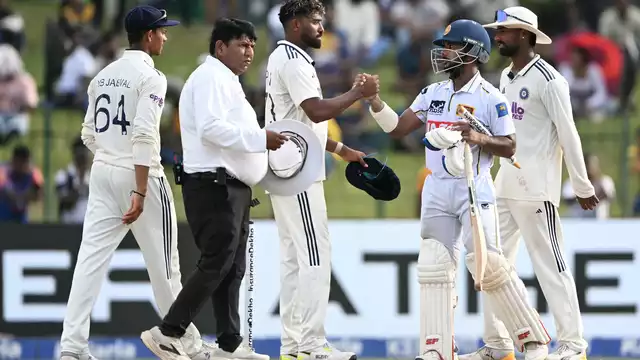
India’s pursuit of victory in the Colombo Test was hampered by challenging conditions at the Sinhalese Sports Club, where the team spent 243.4 overs in the field. Despite entering the match with three spinners, India struggled to break through as the pitch conditions neutralized their primary attack. Shubman Gill noted that on the final three days of the match, the slow turn and lack of bounce rendered LBW and bowled dismissals largely ineffective, leaving close-in catches as the only realistic path to wickets.
The Indian captain addressed criticism regarding his decision to enforce the follow-on after Sri Lanka folded 14 runs short of the target on Day 4. With Saransh Jain claiming his first two Test wickets, India opted to keep the pressure on rather than bat again. Gill maintained that the decision was the best available at the time, noting that rain had already washed out 68.2 overs, and the team had to weigh the risk of batting for a session against the possibility of chasing a target quickly. He insisted the strategy did not backfire, as the team had to adapt to the reality that traditional dismissal methods were not in play.
Sri Lanka’s resistance was anchored by Sonal Dinusha, who proved to be a significant obstacle for the Indian bowlers. Dinusha’s defensive technique and proficiency with the sweep shot—scoring 173 runs via sweeps across the two-Test series—frustrated India’s attempts to force a result. Gill explained that India’s inability to generate enough pace on the surface meant that even short-pitched deliveries from bowlers like Prasidh, who consistently hit 135-140kmph, could not unsettle the batter.
Tactical adjustments were constant throughout the final day. India initially crowded the bat to force breakthroughs, but as Dinusha and Keshara Nuwantha built their partnership, Gill was forced to spread the field to prevent easy runs. Following the dismissal of Nuwantha after lunch, India struggled to remove the tail, with Prabath Jayasuriya and Lahiru Kumara showing remarkable resilience. Jayasuriya faced 28 balls for his two runs, while Kumara dug in for 90 deliveries to score 12, effectively stalling India’s progress.
Gill acknowledged the disappointment of failing to secure a win after amassing a large first-innings total and reducing Sri Lanka to 8/2 by the end of the second day. However, he credited the opposition for their defiance, noting that playing in home conditions often gives teams an advantage that is frequently overlooked. He emphasized that India had been the dominant side for the majority of the last 8-9 days of cricket.
Looking ahead to the World Test Championship standings, India currently sits in fifth position with a points percentage of 51.52%. Despite the draw complicating their path to the top two, Gill remains optimistic about their qualification chances. He expressed confidence that a strong performance in the upcoming two-Test series against New Zealand would put India in a favorable position to secure a spot in the final. The report also notes that where they spent 243.4 overs in the field, had become cyclical, with one leading to and compounding the next, india’s troubles in the Colombo Test. The report also notes that the data should tell you the spinners should’ve been delighted at the SSC: the average degree of turn just kept getting bigger as the Test progressed and balls turned sharp consistently. The report also notes that we felt that on Day 3, 4 and 5, the mode of dismissals – LBW and bowled – were completely out of the game, because the ball that was turning, was turning very slow and with bounce,” Gill said after the drawn fixture. The report also notes that which is catch at silly point, short leg or slip, so only one mode of dismissal was left if the batters were defending. The report also notes that the wicket got even slower, as the day went. The report also notes that india looked at the potential overheads and went for the jugular. The report also notes that they decided to extend their stay, after being in the field 89.4 overs. The report also notes that i think we fielded for about 250 overs [243.4].