New Zealand captain Mitchell Santner has identified the 8 PM start time and the resulting impact of dew as significant factors contributing to India’s success in the ongoing T20I series. With India now holding a 2-0 lead after successfully chasing in both matches, Santner noted that the hour-later start time compared to the traditional 7 PM slot makes conditions considerably more favorable for teams batting second. He observed that by the second half of the game, the ball tends to skid onto the bat more effectively, prompting both sides to prioritize bowling first after winning the toss. Santner pointed out that T20I matches in New Zealand that usually begin by 7 PM local time are now kicking off at 8 PM instead which makes batting a bit more easier for chasing sides. In both the games so far, India have opted to bowl first and are now leading the series 2-0. We usually start at 7 o’clock, i guess with it being so late (8 PM start). We’ll see how they pull up I guess tomorrow morning. I think the way he’s come in and looks so free from the start.
Regarding the atmospheric conditions, Santner remarked, “There was less dew tonight than there was the first game, I think, because the wind was up a little bit, but I think it’s going to be a factor throughout the series.” Despite a fiercely contested second match, the New Zealand skipper emphasized that the chasing team has held the upper hand in both encounters, consistently managing to capitalize on the shifting pitch behavior as the night progresses.
The hosts faced additional adversity during the latest chase as pacers Matt Henry and Lockie Ferguson were unable to complete their full bowling allocations. Santner explained that these departures were purely precautionary measures intended to protect the players ahead of the upcoming ODI and Test fixtures. “Matt experienced a tight calf, so we didn’t want to risk it with the amount of cricket we’ve got coming up,” he stated, noting that the team is monitoring both bowlers’ recovery status daily to ensure they are available for the remainder of the tour.
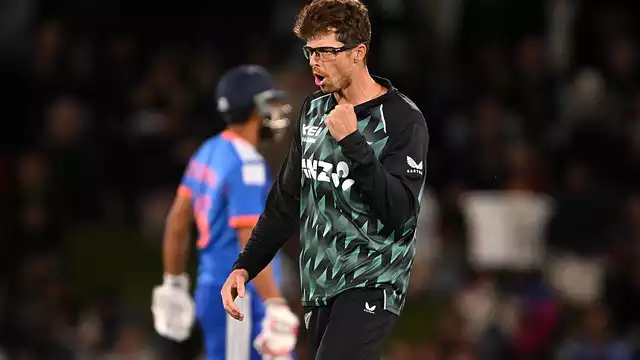
On the field, Santner delivered a standout performance with the ball, claiming 4/21, though his efforts were eventually neutralized by a resilient partnership from India’s middle order. He praised Tilak Varma, Naman Dhir, and Nitish Reddy for their composure during the critical final stages. Santner highlighted Varma’s growth as a finisher, noting that his experience in the middle and death overs—honed during their time together at the Mumbai Indians—was pivotal in guiding India home. Finishing with figures of 4/21 before the trio of Tilak Varma, Naman Dhir and Nitish Reddy scripted a turnaround to clinch the contest for India, the New Zealand skipper had a terrific outing. He was batting three and it’s a slightly different role,” Santner observed. “So I guess the middle order role is very depending on how you operate in the middle and in the death phase, santner reserved praise for the half-centurion alongside whom he has been playing in the IPL for Mumbai Indians. “I guess when he (Tilak) first started.
Indian all-rounder Nitish Reddy described the turning point of the chase as a tactical shift when the team needed 69 runs from 31 balls with only four wickets remaining. By securing one productive over to shift the pressure back onto the New Zealand bowlers and cleverly utilizing the ground dimensions for quick running and timely boundaries, the pair successfully kept the target within reach. “We were just talking like we have to believe that we’re going to get one strong good over,” Nitish explained, crediting their partnership for keeping the chase alive under immense scoreboard pressure. Nobody likes to get injured but it’s just something which I’m working on and I’m happy that I’m playing for the Indian team and it’s about each and every day. The next day if I turn up and play for my team that would be a great sign for me no matter where I play but I hope I don’t get injured. For the good balls also we had twos and then the bad balls we punished it for boundaries, we would just keep believing in it and the kind of running between wickets we had.
Addressing his personal battles with injury, Nitish characterized the recovery process as an expected component of his development as a multifaceted cricketer. Balancing high workloads across batting, bowling, and fielding training sessions remains his primary focus. He expressed gratitude for his opportunity with the national team, stating that he is committed to staying fit and performing consistently regardless of the venue, with the hope that he can avoid future physical setbacks during this demanding tour.