When Leicester City faced Liverpool in the Premier League, few predicted that within 15 months they would be taking on Notts County, Burton Albion, and MK Dons in League One. Yet, a path of consecutive relegations to English football’s third tier that was once extraordinarily rare is statistically becoming more common, with Burnley now facing the threat of joining that list. Are Burnley set to follow a growing trend.
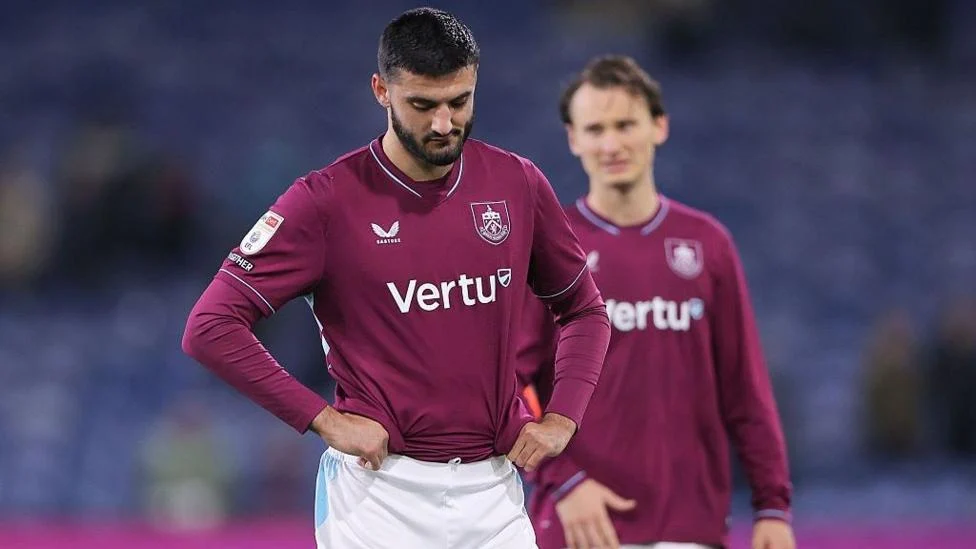
For the 1,450 Burnley supporters who traveled to Lincoln City last weekend, the danger is stark. Head coach Nicky Hayen was unlikely to remain in his post following a 4-1 defeat to a Lincoln team that was playing non-league football a decade ago. With Diego Lopez coming in as chief football officer and Fabio Celestini named as the new manager, the Clarets are desperate for a turnaround.
Burnley supporters have staged protests against ALK Capital owner Alan Pace for much of the campaign. The club had built a reputation as a yo-yo side, having been promoted or relegated in each of the previous five seasons. However, following ALK Capital’s leveraged buyout in 2020, Burnley carried £142m in loans in their 2024-25 accounts—the highest debt level in the Championship the year they went up. Much will depend upon just how “significantly” the gap is closed. And that should concern any club that gets relegated and is not prepared for life in the Championship.
On the pitch, Burnley recently established a new English league record for the longest run without a home victory. Heading into Saturday’s match against Portsmouth, it has been 378 days since their last home win. The disparity off the pitch remains vast: Burnley recorded £71.7m in total revenue for 2024-25 compared to Lincoln’s £7.81m, alongside receiving £48m in parachute payments against Lincoln’s roughly £5.5m in solidarity funding, yet financial power has not translated to success on the pitch. Lincoln can expect about £5.5m in solidarity funding.
Across the first 20 seasons of the Premier League, back-to-back relegations to the third tier happened only once. That occurred with Swindon Town, who finished fourth from bottom in the second tier in 1994-95 but went down due to division rebalancing aimed at reducing the top flight to 20 clubs. Without that structural adjustment, Swindon would have avoided the double drop.
Consequently, Wolves were arguably the first team to suffer a true double drop from the Premier League after their 2011-12 relegation. Since that period, the collapse has happened four times in 14 seasons, or three times in nine seasons if counted from Sunderland’s drop between 2016 and 2018, followed most recently by successive drops for Luton Town and Leicester City. Other sides like Wigan and Portsmouth fell to League One in their second Championship season, while Leeds United and Sheffield Wednesday fell in their third. Or, after Sunderland went down in 2016-18, three times in nine seasons. They kept hold of too many that didn’t really want to be there and then obviously weren’t equipped to deal with a relegation battle, and for Leicester City. Burney fans may fear there are similarities at Turf Moor.
Off-field instability played a massive role in those slides. During their double drop—having previously suffered a treble drop to the fourth tier during the 1980s—Wolves cycled through four managers and endured a string of failed transfers. Sunderland went down with the unwanted distinction of finishing bottom in back-to-back divisions, winning only 13 of 84 league games despite having spent 10 consecutive years in the top flight, a spell where they reached the 40-point safety mark just three times.
Leicester City’s descent to League One stemmed directly from poor executive decisions, capped by a six-point deduction for breaching profit and sustainability rules. The Foxes finished 23rd in the Championship, five points adrift of safety. Recovery has proved difficult; Sunderland took four years to return to the Championship, while Russell Martin’s Leicester currently sit 11th in League One with the club up for sale, making an immediate promotion look unlikely.
EFL pundit Jobi McAnuff believes these recent collapses are driven by specific internal failures rather than a permanent structural shift. “Despite the fact we’ve seen Luton and Leicester suffer back-to-back relegations in recent years, I don’t see it as a trend that will continue,” McAnuff stated. He cited “mismanagement of the playing squad” at both clubs, noting that some Luton players carried an undue sense of entitlement after top-flight exposure, while Leicester retained too many squad members who wanted to leave and lacked the resolve for a Championship dogfight.
In contrast to other relegated teams, Luton Town maintained relatively sound administrative management. Their drop from the Championship in 2024-25 came down to an inferior goal difference compared to Hull City, who subsequently won promotion to the Premier League the following year. Off the pitch, Luton continues to advance plans for a new 25,000-capacity stadium at Power Court, scheduled to open for the 2028-29 season.
The financial divide between leagues remains a central discussion point. Parachute payments given to relegated Premier League sides—£48m in the first year and £39m in the second—are designed to ease financial adjustments. During 2024-25, four clubs receiving parachute payments finished nearly 27 points better off on average and occupied the top three league places, with Luton as the sole outlier being relegated.
“If you look at the numbers of teams that go back up or finish in the top places, there’s a huge correlation between those clubs and the ones that are parachute payment clubs,” McAnuff noted. “Even with a reduction in parachute payments, I still feel that advantage will prove to be massively significant for those teams.”
Addressing these disparities, the Independent Football Regulator (IFR) stated in its State of the Game report that a revised agreement between the Premier League and EFL must reduce the distortive impact of parachute payments. The proposed alternative centers on merit payments that reflect final league positions, matching the Premier League’s prize structure rather than giving every Championship club an equal baseline distribution regardless of where they finish.
“The amount of money paid in parachute payments will reduce and the amount of money going into the Championship will vastly increase,” explained IFR chair David Kogan, highlighting an upcoming shift in how funding flows down the English football pyramid.