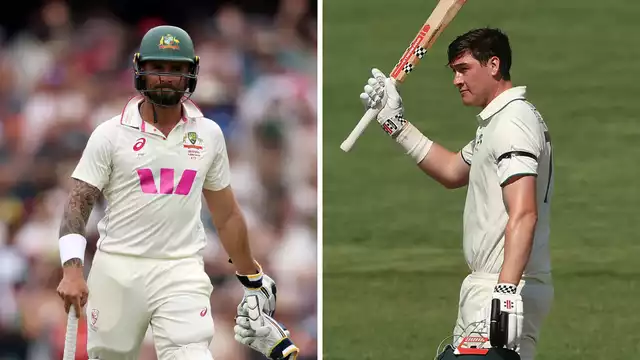
Australia has moved quickly to adjust its batting lineup following a surprising nine-wicket loss to Bangladesh in the Darwin Test. The selectors have dropped Jake Weatherald, opting instead to call up 30-year-old Matthew Renshaw, who is expected to open the batting alongside Travis Head in the upcoming Mackay Test.
Weatherald’s performance in the opening match, his first Test since receiving a national contract in April, yielded scores of 23 and 0. These twin failures, which included an edge behind and an inside edge onto his stumps, pushed his career average across 12 innings down to 20.36. This selection change marks a rapid reversal for the batter, who had previously earned his spot after strong showings during Australia’s 4-1 Ashes victory. Coach Andrew McDonald noted that while Weatherald had made technical adjustments to his movement and alignment to mitigate previous weaknesses, the small sample size made it difficult to determine if those changes would hold up under international pressure.
Renshaw enters the squad as a natural replacement, buoyed by a strong domestic season where he was the top-performing Sheffield Shield opener, averaging just under 50 with three centuries in 10 innings. He also possesses familiarity with the Mackay venue, having scored two first-class hundreds there. Although his last international appearance was three years ago in Delhi, he brings 14 Tests of experience to the side. Alternatively, the team retains 13-man squad member Josh Inglis, who has previously been identified as a top-order option and successfully opened for the Cricket Australia XI against the England Lions last November with scores of 40 and 125 not out.
The team is also facing scrutiny regarding the form of Marnus Labuschagne at No. 3. Labuschagne managed only 1 and 31 in Darwin, extending a difficult period where he has failed to score an international century for nearly three years. His average over his last 42 Test innings sits at 25.23, raising concerns about his consistency.
McDonald acknowledged the pressure on Labuschagne, noting that while the batter looked composed during his second-innings effort in Darwin—moving well and timing the ball effectively—the final output remained insufficient. The coach emphasized that the staff is working closely with Labuschagne to regain his form, stating, “It’s easy for me to sit here and try to defend that. But ultimately, it’s 31. It’s not a big score. He’s lacked runs. He feels that. We feel that.”
Despite the low scores, the coaching staff remains optimistic that the technical work Labuschagne has been doing is beginning to take hold. McDonald observed that some of the adjustments made to his batting style appeared to remain effective even under the pressure of the match, providing a foundation for the team to build on as they look to level the series in Mackay. The report also notes that the decision is a swift reversal after Weatherald had been rewarded for his performances alongside Head during Australia’s 4-1 Ashes triumph. The report also notes that he dragged one on and drove at one in the first innings and was dismissed; it’s probably harder with that smaller sample size to say, ‘Yep, that’s going to hold up under pressure’. The report also notes that although his most recent appearance came in Delhi three years ago, when he was batting in the middle order, renshaw has 14 Tests behind him. The report also notes that it’s always hard to critique small sample sizes on whether it holds up [at international level].