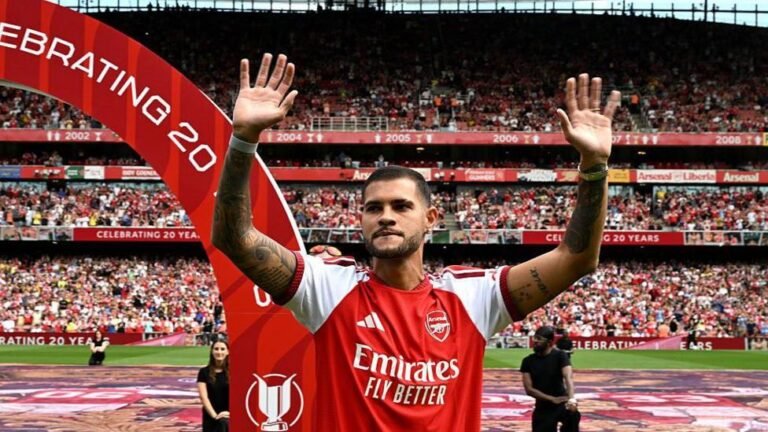

Barcelona captain Ronald Araujo has arrived in Liverpool after joining the club on a season-long loan, with the move including an option for the Reds to make the deal permanent for 55m euros (£47.1m). The Uruguay international, who joined Barcelona from Boston River in 2018 and has since made 213 first-team appearances, will wear the number 33 shirt at Anfield.
For the Premier League side, it is an opportunity to bring in an experienced defender at a crucial time. For Araujo, it represents a chance to make a fresh start away from Barcelona. New Liverpool head coach Andoni Iraola gave the move the go-ahead last week and spoke to Araujo via phone before the defender traveled to England. Araujo has taken a pay cut for the coming season, and Liverpool will cover his salary for the duration of his loan spell.
The structure of the deal reflects Liverpool’s need to solve an immediate problem rather than make a long-term commitment at this stage. The club wanted a defender who could operate at both centre-back and right-back, and Araujo’s versatility and physical profile made him an attractive option. The timing is particularly significant as Conor Bradley, Joe Gomez, and Giovanni Leoni are all injured, while new signing Jeremy Jacquet has yet to feature in pre-season.
With Ibrahima Konate having left for Real Madrid earlier in the summer, Virgil van Dijk is currently Liverpool’s only fit senior centre-back. While Liverpool still believe that their stock of centre-backs will serve them well for the coming season and beyond—noting that Jacquet, Leoni, Mor Talla Ndiaye, and Ifeanyi Ndukwe are all emerging players—Araujo was viewed as a player capable of helping the team through this immediate period.
His strength, pace, and experience at one of Europe’s top clubs were identified as key assets. At Barcelona, his acceleration allowed the team to defend a high line with confidence, while his 6ft 4in (1.93m) frame made him a formidable presence in physical contests and aerial duels. He finished last season as captain, making 38 appearances for Hansi Flick’s side in the 2025-26 campaign.
Barcelona head coach Hansi Flick addressed the departure in a recent press conference, stating, “He is a very good person and an exceptional player, but our style of play is slightly different. He is a footballer with great speed and power, and he is good with the ball at his feet, too. I wanted to get him involved; I think he is eager to try new things, and I believe he has also been affected by what happened in the past.”
The “past” Flick referred to includes several high-profile moments where Araujo’s performances came under intense scrutiny. His red card against Paris St-Germain in the 2024 Champions League quarter-finals was a defining moment, as his dismissal helped turn the tie in PSG’s favour. He was also heavily criticised for mistakes in the second leg of the 2025 Champions League semi-final defeat by Inter, though Flick publicly defended him at the time.
Last season, in a 3-0 Champions League away defeat by Chelsea, Araujo was sent off just before half-time after receiving a second yellow card for a foul on Marc Cucurella. A week later, he was granted a leave of absence to prioritise his mental health and received professional support to “take care of himself emotionally.” He returned a month later and made 23 appearances over the second half of the season, starting six matches.
There is also a significant financial benefit for Barcelona in this arrangement. The club has been looking to generate funds to ease financial pressures, and although this is only a loan with an option to buy, Liverpool covering Araujo’s full salary represents a substantial saving for the Catalan club. As one of Barcelona’s highest earners, his departure provides immediate relief to the club’s wage bill.
Araujo joined Barcelona from his native Uruguay in 2018, made his first-team debut the following October and has since gone on to make more than 200 appearances for the Catalan club.
“I said goodbye to him this morning and saw that he was happy.
His leadership capabilities were also seen as a positive factor.