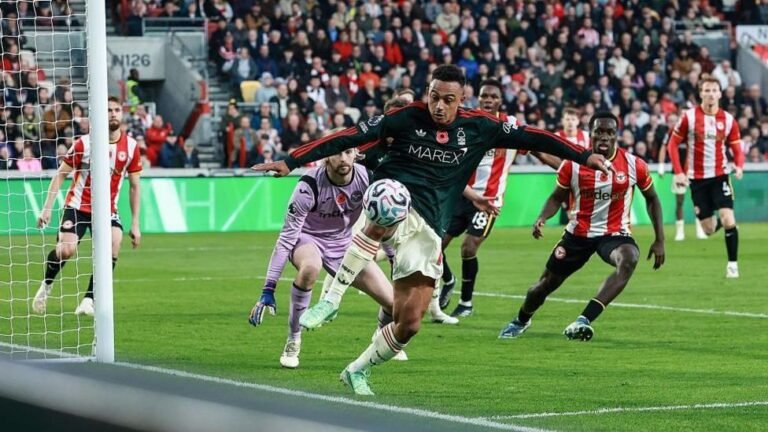
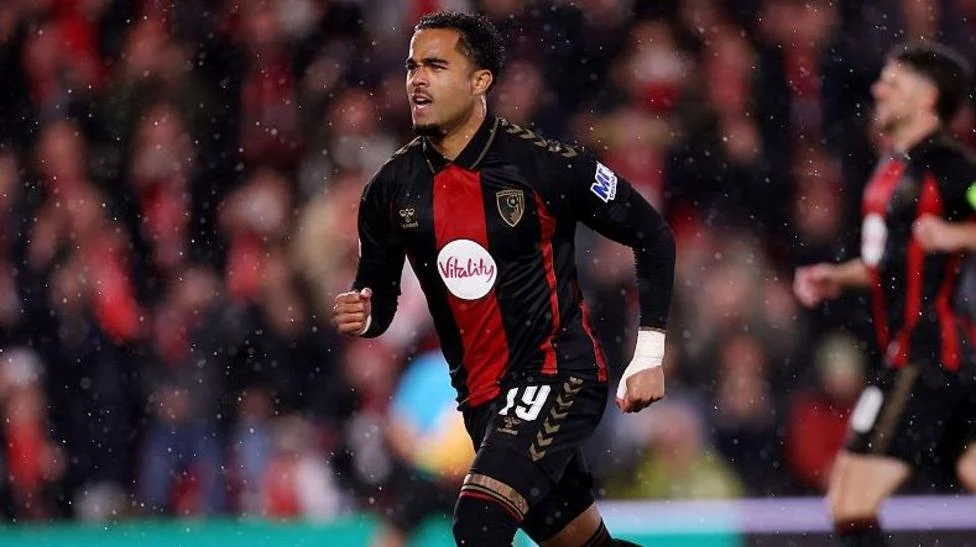
Bournemouth delivered a standout performance on Thursday night, securing a convincing 3-0 victory over seven-time European champions AC Milan at Vitality Stadium in what was only their third fixture in continental competition.
Justin Kluivert opened the scoring for the hosts, coming 31 years after his father, Patrick Kluivert, scored Ajax’s winning goal against AC Milan in the 1995 Champions League final. The result marks another high point for a club that narrowly avoided liquidation in 2008 and was languishing in 17th place in League One fifteen years ago today. Not many Bournemouth fans would have dreamed that famous name would one day appear on their shirts, having seen their club narrowly avoid the jaws of liquidation in 2008. Bournemouth sweep aside 10-man Milan in Europa League. Brighton winning run ends with dull draw against Jablonec. Wasteful Sunderland held to draw at Lech Poznan.
Reflecting on the milestone, Bournemouth midfielder Ryan Christie spoke to TNT Sports about the club’s remarkable trajectory. “It’s mega. In terms of the story of the club it’s ridiculous. Someone told me today, 15 years ago today we were 17th in League One, so it’s pretty incredible,” Christie said. “So many of these fans have been here for this journey so to have nights like this and win as well is special.” At times, being a Bournemouth fan must feel like living in a simulation.
The match turned decisively after 27 minutes when AC Milan goalkeeper Mike Maignan was sent off, though Bournemouth had dominated proceedings prior to the red card. In a curious twist, Milan fielded three English players in their starting lineup, whereas the English hosts started just two.
Bournemouth’s European campaign has already seen them defeat Real Sociedad, Sturm Graz, and now Milan. Remarkably, all three beaten opponents have featured in the Champions League within the past three years, contrasting with Bournemouth’s current domestic form of just six points from seven league matches while Milan occupy fourth place in Serie A.
The victory reflects a broader pattern of English dominance across European competitions this season. Premier League clubs played nine European matches this week, suffering just a single defeat. Overall, English sides have lost only four of 26 matches in continental competitions so far this season, with Manchester United accountably responsible for two of those losses. So, why are English clubs so dominant in Europe’s secondary competitions – and why hasn’t this transferred to consistent Champions League glory.
This sustained form builds on recent history. Over the past two seasons, Premier League clubs have contested 21 knockout ties against non-English European opponents across the Europa League and Conference League, winning every single one. The only knockouts English teams suffered in those competitions were at the hands of fellow domestic rivals.
Financial disparity remains the primary driver behind this competitive divide. In the five seasons since the Conference League’s inception, Premier League sides have won two of the three continental trophies in three separate years. Last season, Aston Villa comfortably beat Freiburg in the Europa League final while generating double the German club’s revenue, and Crystal Palace claimed the Conference League title while boasting nearly four times the revenue of runners-up Rayo Vallecano. Sage denied win but Palace earn hard-fought point at Besiktas.
The domestic depth of English football is equally striking. In 2025, Tottenham Hotspur defeated Manchester United in the Europa League final despite the two teams finishing 17th and 15th in the Premier League respectively. Similarly, West Ham United lifted the Conference League trophy in 2023 after finishing 14th domestically. In 2022-23, West Ham finished 14th and won the Conference League.
Deloitte’s 2026 Money List highlighted this wealth gap, placing 15 of last season’s 20 Premier League teams within the global top 30. English top-flight clubs generate over £1.37bn per season in television rights alone, matching the combined domestic broadcasting revenue of La Liga, Serie A, the Bundesliga, and Ligue 1.
This financial strength was on display during the summer transfer window, where Premier League clubs set a record spend of £3.49bn. Out of the 20 most expensive player transfers completed globally, 14 were made by English top-flight sides, allowing mid-table English teams to regularly outbid established European giants for elite talent. With the latter again setting a new transfer spend record of £3.49bn to dwarf their rival leagues, the summer transfer window was further evidence of Europe’s struggles against the Premier League.
Speaking in August on the financial shift, sports finance expert Kieran Maguire noted: “With the exception of some of the global brands within football, and I think you’d look at Real Madrid, Barcelona, PSG and Bayern Munich, the Premier League can outspend anyone and everyone. A significant proportion of overseas players are now choosing to play in England than elsewhere in Europe because of the wages on offer.” But for the rest of Europe, is it a Premier League-induced nightmare, for them it’s a fairytale. Take away Europe’s richest and England dominates.
However, despite overwhelming success in the Europa League and Conference League, complete dominance in the Champions League remains elusive for English teams, with Manchester City being the only Premier League club to lift the trophy in the past five years. Arsenal also reached last season’s final, losing on penalties.
In contrast, continental powerhouses continue to hold the edge at the very highest level. Over the past two campaigns, eight out of nine English teams were eliminated from the Champions League by the Deloitte Money League’s top four clubs—Real Madrid, Barcelona, Bayern Munich, and Paris Saint-Germain. Last season, Chelsea, Manchester City, Newcastle, and Liverpool were knocked out by an aggregate score of 25-6 by these European giants, who have claimed five of the last seven Champions League titles.