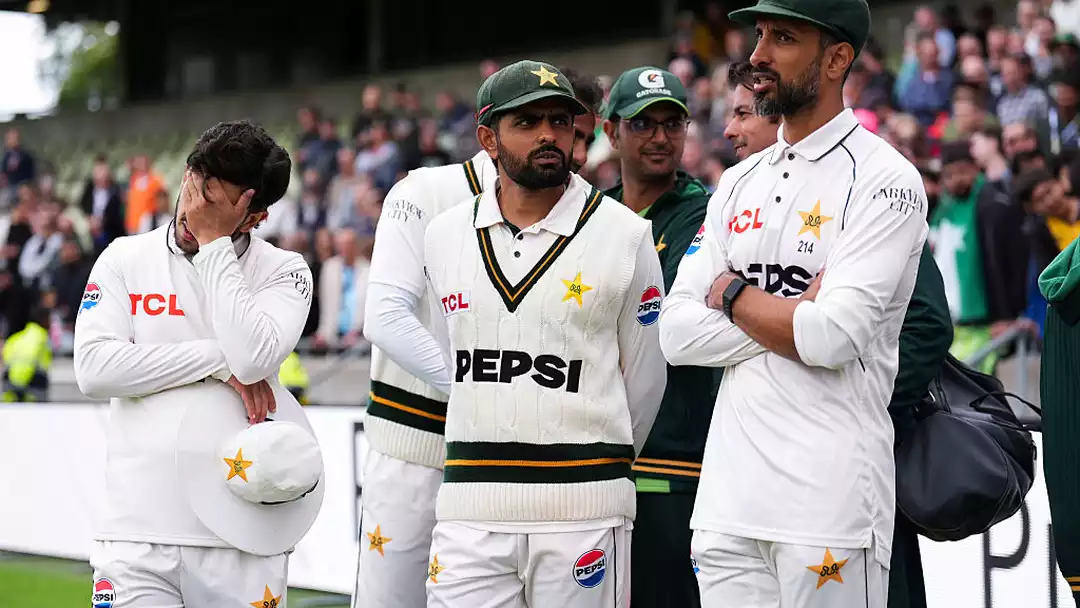
Pakistan cricket is currently navigating a profound Test match crisis, defined by a systemic inability to secure victories and persistent instability in its leadership. The team’s recent 3-0 sweep at the hands of England—which included losses by an innings and 103 runs, 194 runs, and eight wickets—marks the second time England has whitewashed them in as many years. This result signifies a worrying trend: it is Pakistan’s 11th series loss by a 0-3 margin and their ninth such defeat in a three-Test series during the 21st century, placing them ahead of Sri Lanka, who have recorded five.
This instability extends to player selection. Since the beginning of the second World Test Championship (WTC) cycle in August 2021, Pakistan has utilized 43 different players across 37 Test matches. After the initial core of 11, the team introduced 32 additional players, a turnover rate of 0.89 new players per Test. Among the nine WTC-participating nations, only South Africa has seen a higher turnover, largely due to their decision to field a second-string side in New Zealand during the 2023-24 season to accommodate the SA20 league.
The lack of consistency is reflected in the team’s inability to field a stable lineup. Pakistan has managed to field an unchanged XI in only three of their last 37 Tests: against Bangladesh in Dhaka in 2021, Sri Lanka in Colombo in 2023, and England in Rawalpindi in 2024. Consequently, no specialist bowler has featured in more than 18 of these 37 matches, with Noman Ali leading the rotation. Among fast bowlers, Shaheen Afridi has appeared in only 17 matches, and no batter has played in every game, with Babar Azam (33), Mohammad Rizwan (32), and Salman Agha (28) recording the highest appearance counts.
The coaching structure has seen even more volatility. Since Misbah-ul-Haq and Waqar Younis resigned in September 2021, the team has cycled through Saqlain Mushtaq, Grant Bradburn, Mickey Arthur, and Mohammad Hafeez. In 2024, the Pakistan Cricket Board (PCB) split coaching roles, appointing Jason Gillespie before moving to a new setup. Most recently, former captain Sarfaraz Ahmed was named red-ball head coach ahead of the 2026 Bangladesh series, only to be dismissed alongside his bowling coach following the losses at Leeds and Lord’s.
Performance metrics underscore the severity of this decline. Pakistan finished seventh in the 2021-23 WTC cycle with a 38.1% points percentage, dropped to ninth in 2023-25 with 27.98%, and currently sits at the bottom of the table. Their overall win-loss ratio of 0.987 has now dipped below 1.0, and they currently hold the second-worst win-loss ratio (0.5) among WTC nations since August 2021, trailing only the West Indies.
While traditional powerhouses like South Africa, Australia, and England maintain strong home records with win-loss ratios of 5.5, 5.0, and 2.2 respectively, Pakistan’s home advantage has effectively evaporated. They have struggled significantly on the road as well; in their last 20 away Tests, they have lost 13 and won only seven. They remain winless in all SENA (South Africa, England, New Zealand, Australia) countries since 2018, suffering 17 defeats and two draws in 19 matches. Their only victory outside of Asia since 2021 was against the West Indies.
Batting struggles have further compounded these issues. In 37 Tests since August 2021, Pakistan has been dismissed for under 250 runs in 32 different innings, with 18 of those totals falling below 200. During the recent England series, the team was bowled out for under 200 in five consecutive innings. Their combined batting average of 28.46 in this period ranks sixth among WTC teams, with no player maintaining an average above 45. Babar Azam leads the scoring with 2602 runs at 43.4, while Shan Masood has scored 1548 runs at 32.25.
Historically, Pakistan relied on pace to drive success, but recent statistics reveal a sharp decline in this area. Since the 2021-23 WTC cycle began, their pace bowlers have taken 305 wickets at an average of 32.7 and a strike rate of 55.7, both of which are the second-worst among all WTC teams. Shaheen Afridi is the only pacer to have taken 68 wickets, while Mohammad Abbas remains the only other bowler to cross the 45-wicket threshold in this timeframe.
Conversely, the team has become increasingly reliant on spin, particularly in home conditions. In their 11 victories since August 2021, spinners accounted for 144 wickets at an average of 20.17, including 10 five-wicket hauls. In their 22 defeats, spinners took only 110 wickets at an average of 43.8 with four five-wicket hauls. This reliance was highlighted during the 2024 home series against England, where Noman Ali and Sajid Khan combined to take 39 of the 40 available wickets in the final two Tests. The report also notes that pakistan Cricket’s current crisis goes beyond a bad series or a few underperforming stars. The report also notes that the latest episode is particularly Bleak. The report also notes that pakistan lost all three Tests on their 2026 England tour – by an innings and 103 runs, 194 runs and eight wickets – as England completed a 3-0 sweep of Pakistan for the second time, after 2022/23. The report also notes that their sixth whitewash in 12 multi-Test series over the last four years, and their ninth 0-3 loss in a three-Test series in the 21st century – the most by any team, ahead of Sri Lanka (five), it was Pakistan’s 11th series loss by a 0-3 margin. The report also notes that with former Test coach Jason Gillespie’s criticism of frequent U-turns raising questions about selection, consistency and long-term planning, the moves have put Pakistan cricket under fresh scrutiny. The report also notes that especially in Tests and major tournaments, the numbers suggest a deeper problem: a team capable of individual brilliance but struggling to turn it into sustained success. The report also notes that they introduced 32 more across the next 36 matches – 0.89 new players per Test, after the first 11 players. The report also notes that only South Africa (26), England (24) have more in this regard.