
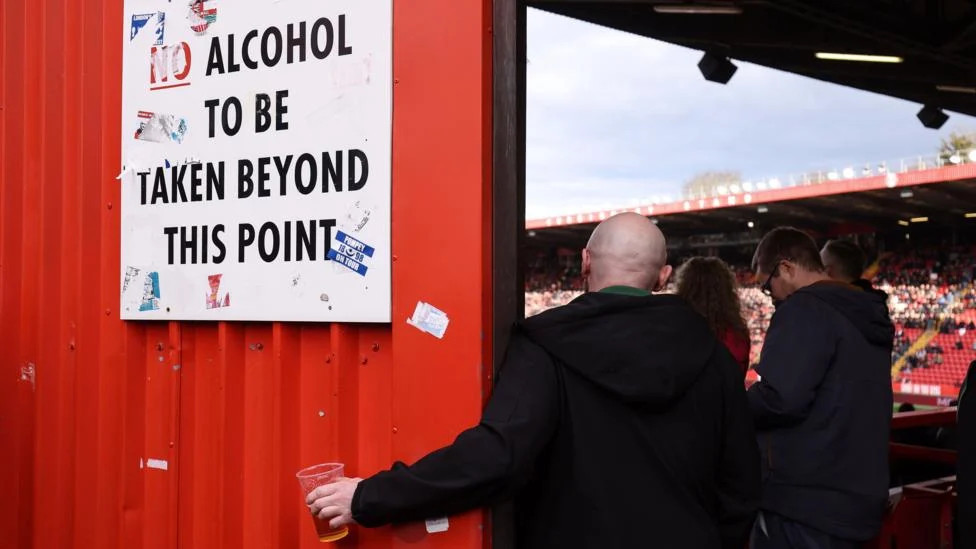
Prime Minister Andy Burnham has publicly criticized the long-standing prohibition on drinking alcohol within sight of the pitch during men’s professional football matches in England. Describing the restriction as a form of discrimination, the Prime Minister argued that football fans are being unfairly singled out compared to supporters of other sports, such as rugby league, where drinking in the stands is permitted.
The legislation, which has been in place for the top five tiers of English men’s football since 1985, was introduced by Margaret Thatcher’s government. At the time, then-Home Secretary Leon Brittan justified the measure by identifying alcohol as a significant factor in violent and disorderly conduct within stadiums. Speaking during a trip to the United Nations in New York, Burnham noted that while the law originated in a different era of the sport, he believes there is a legitimate case for its removal.
Government sources have clarified that the Prime Minister’s comments represent a long-held personal view rather than a formal change in policy. While officials have not ruled out the possibility of a future pilot scheme to test potential reforms, they emphasized that no such plans are currently underway. Any broader legislative move would require extensive consultation with police, football clubs, and the Department for Digital, Culture, Media and Sport.
The Football Supporters’ Association (FSA) has welcomed the Prime Minister’s remarks, with chairman Tom Greatrex arguing that criminalizing fans for enjoying a drink is outdated. Greatrex pointed out the inconsistency of the current rules, noting that spectators can consume alcohol while watching rugby or major events like an Oasis concert in the same stadiums where football fans are barred from doing so. The issue was previously highlighted in a 2021 fan-led review of football governance, which recommended a formal re-examination of the legislation.
Despite the support for reform from many clubs, senior police figures remain strongly opposed to relaxing the rules. A spokesperson for the UK Football Policing Unit warned that changing the law would introduce significant challenges regarding the safety of staff and fans. They argued that football continues to experience unique instances of violence and criminality linked to alcohol that are not mirrored in other sports, making it irresponsible to increase consumption during matches.
Police chiefs have requested a meeting with the Prime Minister to detail these operational risks and discuss why they believe current protections remain necessary. Meanwhile, other areas of the sport have seen changes; all Women’s Super League (WSL) clubs were granted permission this season to allow alcohol in the stands following two years of successful pilots. In Scotland, where a broader ban has existed since 1981, authorities have also begun conducting trial sales, including at Hampden Park, reflecting a growing conversation about the future of stadium alcohol policies. The report also notes that a Wrexham fan holds his pint of beer while watching his team play Charlton Athletic. The report also notes that but I’m not going to back away from what’s been a long held view of mine. The report also notes that i don’t see how it can be fair that some supporters of one sport can be treated differently. The report also notes that he added it would be “incredibly rash to make fundamental changes without a full examination of the evidence and meaningful consultation with police practitioners who have the expertise in this area”. The report also notes that where the general sale of alcohol has been prohibited in Scottish football stadiums since 1981, but trial sales have been taking place recently and fans can now buy alcohol at Hampden Park games, the law is more restrictive in Scotland.