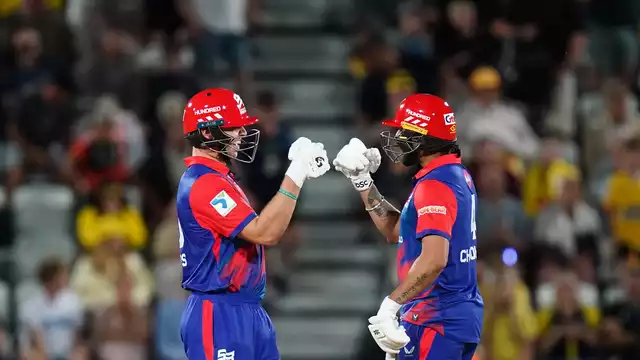
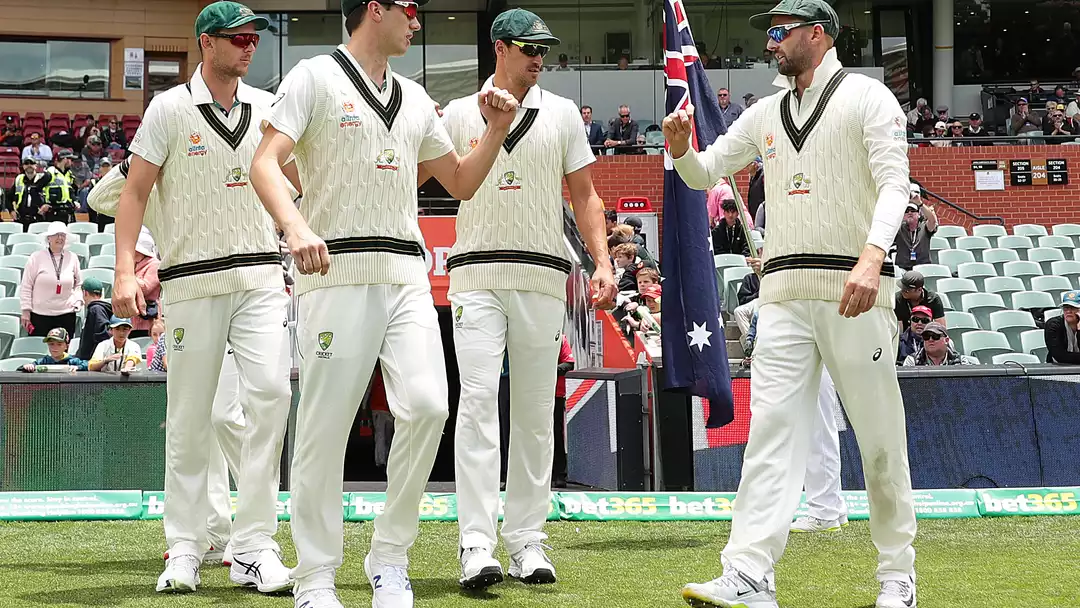
For all the legendary bowling line-ups to have graced Test cricket, the current Australian quartet of Pat Cummins, Mitchell Starc, Josh Hazlewood, and Nathan Lyon is on the brink of an historic and perhaps unsurpassable feat. They are currently in line to become the first quartet in Test history to play together in a match where each member has 300-plus career wickets. Josh Hazlewood is currently just five scalps away from reaching this prestigious 300-wicket milestone.
As things stand, the four bowlers have a combined total of 1610 Test wickets. When they last played together over a year ago, the Australian line-up collectively boasted 1613 wickets, a figure that included contributions from Cameron Green and various part-time bowlers. The all-time record for the most wickets held by a team’s playing XI heading into a Test match stands at 1989, a benchmark set by England before the 2023 Ashes decider at The Oval, largely due to the presence of James Anderson and Stuart Broad, with the latter retiring at the conclusion of that match.
In 35 matches played together, these four bowlers have collectively bagged 567 wickets. No other quartet in the history of the game comes remotely close to this level of productivity, with the next best quartet managing only 415 wickets. Their efficiency is staggering, as they have collectively accounted for 16.2 scalps per game. The distribution of their success is remarkably balanced; only 16 wickets separate the highest contributor, Pat Cummins with 150, and the lowest, Nathan Lyon with 134. Never before has there been a set of four bowlers where each individual has taken 75-plus wickets in matches played together, provided all four delivered at least one ball in every shared appearance.
Another telling statistic is Australia’s win-loss ratio of 2.444 across these matches. Of the nine defeats Australia has suffered in games where all four played, five were against India, three against South Africa, and one was the historic West Indies victory at the Gabba in 2024. Nathan Lyon has been the workhorse, sending down 711.1 overs across 31 second-innings appearances, averaging roughly 23 overs per innings, whereas none of the other three have bowled more than 500 overs in similar scenarios.
The longevity of this group is nearing its conclusion, as three of the four are aged 35 or older, with Pat Cummins at 33 being the only member under that threshold. Australia has struggled to develop new specialist seamers, with only five debuting since the 2017/18 Ashes. The two leading prospects, Scott Boland and Michael Neser, are both over 35. Nathan Lyon has remained the constant in the spin department, as Matthew Kuhnemann and Todd Murphy have combined for only 12 Test appearances, with only two of those matches occurring without Lyon in the side.
Beyond their Test dominance, Cummins, Starc, and Hazlewood hold the unique distinction of being the only specialist bowling trio to have won both the 2023 ODI World Cup and the 2021 T20 World Cup. Meanwhile, Adam Zampa has maintained the spin-bowling fort in white-ball cricket, standing as one of only three cricketers with over 200 white-ball appearances but zero Test caps for a full-member nation.
Historical comparisons highlight the rarity of this quartet. Famous groups like Colin Croft, Joel Garner, Michael Holding, and Andy Roberts took 172 wickets in 11 matches, while the legendary Shane Warne, Glenn McGrath, Jason Gillespie, and Brett Lee partnership claimed 265 wickets in 16 Tests. The Australian quartet’s consistency is further evidenced by their performance in home and away conditions. In 24 home matches played together, they averaged 25.2 while striking at 53.8. Even when analyzing their overall careers, the variance between home and away averages remains remarkably low, at just 1.8.
The pace trio of Cummins, Starc, and Hazlewood first united during the 2017/18 Ashes opener. Their individual and collective impact remains unmatched in modern cricket. While other pace trios like Croft, Garner, and Roberts have had impressive runs, the current Australian group’s ability to maintain high performance levels across different formats and conditions sets a new standard. Their legacy is not just defined by the volume of wickets, but by the sustained pressure they apply to opposition batting lineups.
The reliance on this specific group is evident in the lack of depth in the current Australian bowling pipeline. As the quartet approaches the twilight of their careers, the challenge for Australian selectors will be transitioning to a new generation without a significant drop in performance. The sheer volume of overs bowled by Lyon, in particular, underscores the difficulty of replacing such a specialized skill set in the current domestic landscape.
Statistical analysis confirms that this group is not merely a collection of talented individuals, but a cohesive unit that has redefined the expectations for a bowling attack. Their 16.2 wickets per game average is a testament to their ability to take 20 wickets consistently, which is the primary requirement for winning Test matches. The fact that they have maintained this level of output over 35 matches is a feat that may not be replicated for decades.
As Australia looks toward future series, including the upcoming challenges against India, the focus remains on whether this quartet can continue to defy age and injury. Their collective experience provides a tactical advantage that is difficult to quantify but clearly visible in their win-loss record. The upcoming milestones for Hazlewood and the group as a whole serve as a reminder of the unique era of Australian cricket that is currently unfolding.
Ultimately, the legacy of Cummins, Starc, Hazlewood, and Lyon will be measured by their ability to close out their careers at the pinnacle of the sport. They have provided a blueprint for consistency, diversity in skill, and partnership that future Australian bowlers will strive to emulate. Whether or not they reach the 300-wicket quartet milestone in their next match, their place in the history of the game is already firmly secured by the sheer weight of their collective achievements.
All four have done almost equal damage, just 16 wickets separating the highest (Cummins -150 ) and the lowest (Lyon – 134).
Colin Croft, Joel Garner, Michael Holding, Andy Roberts: 172 wickets in 11 matches at 24.12, 15.64 wickets per game, W/L ratio: 5
Malcolm Marshall, Garner, Holding, Roberts: 90 wickets in six matches at 26.33, 15 wickets per game, W/L ratio: NA (Won 3, Drawn 3)
Beyond those records and plain numbers however, their collective impact and the legacy warrants a deep dive.
In a league of their own – diverse, consistent and equal partners in crime
For those of you wondering about some surprise exclusions- whether driven by nostalgia or otherwise – here’s a quick guide
Shane Warne, Glenn McGrath, Jason Gillespie, Brett Lee: 265 wickets in 16 Tests at 27.93, 16.56 wickets per game, W/L ratio: 5
Bishan Singh Bedi, Bhagwath Chandrasekhar, Karsan Ghavri, Erapalli Prasanna: 133 wickets in eight matches at 26.26, 16.62 wickets per game, W/L ratio: 2.5
It’s notable that the percentage of total team wickets they have taken across the 35 games played together reads 93.87% (excluding run-outs).
This is impressive when compared to the quartets with a similar sample sizes in the table above, given that the third or fourth bowler in all others is either a genuine all-rounder or a part-timer.
Among the other notable quartets, Croft, Garner, Holding and Roberts accounted for 95.02% of the team’s wickets in 11 Tests played together.
That number shoots up to 97.82% when Croft is replaced by Marshall in the group, the four quicks bagging 90 out of 92 wickets (barring run-outs) in the six Tests.
Another standout stat that the Australians boast is that in their first series together – the Ashesin 2017/18 – all 87 wickets bagged by Australia bowlers were shared by the four: Cummins (23),Starc (22), Hazlewood (21) and Lyon (21).
There have been only two other instances of four different bowlers from the same team bagging 20 or more wickets in a Test series: Ian Bishop (27), Courtney Walsh (26), Kenny Benjamin (22) and Curtly Ambrose (21) on the 1995 England tour; and Stuart Clark (26), Shane Warne (23), Glenn McGrath (21) and Brett Lee (20) in Ashes 2006/07.
The other crucial point of comparison is almost identical numbers in home and away Tests.
The corresponding numbers for the 11 away (and neutral) games read 27.4 and 53.3.
Of the four, only Starc has a considerable dip in home average versus away (26.6 vs 32.75).
The number (absolute values) reads 1.8 for Lyon, 2.11 for Starc, 3.52 for Hazlewood and 5.1 for Cummins.
Among all the quartets mentioned above, there are only two which feature all four with 150-plus career wickets and a notably low difference in home and away averages: Warne (1.78), McGrath (1.62), Gillespie (2.53) and Lee (5.23); and Holding (0.11) Garner (2.6), Roberts (4.87) and Marshall (1.52).
Setting it up – the Aussie pace troika
The three first united in the Ashes 2017/18 opener in Brisbane, after Cummins had made a comeback to the Test setup earlier that year, with 1940 days separating his debut and second appearance.
Australia’s trio have impressive numbers compared to most others in the above list.
If we include pace troikas with a minimum of 200 wickets, the great West Indies pace attacks from the Seventies and Eighties are right there with them and the New Zealand trio of Trent Boult, Tim Southee and Neil Wagner in terms of average wickets bagged per match.
West Indies won 16 out of 26 Tests in which Malcolm Marshall, Joel Garner and Michael Holding featured together, losing just one (Sydney, 1984/85).
Croft, Garner, Holding: 16 Tests, 208 wickets, 13 wickets/match, W/L: 2.5
Croft, Garner, Roberts: 18 Tests, 232 wickets, 12.89 wickets/match, W/L: 4.5
Garner, Holding, Marshall: 26 Tests, 331 wickets, 12.73 wickets/match, W/L: 16
This pertains to the number of wickets taken by a first-change seamer in Tests, where Cummins has every chance of overtaking Ian Botham and Morne Morkel.
Lyon currently is the sixth-highest wicket-taker in Tests (567), and only Starc has 400-plus scalps among active bowlers.
The hallmark of his career has been his longevity: he is the only bowler with 100 consecutive Test appearances, the next best sequence among specialists is 60 for Anil Kumble.
If we factor in all-rounders, it’s Garry Sobers (85), Kapil Dev (separate streaks of 66 and 65), Ian Botham (65) and Jacques Kallis (60).
No other Australian spinner has challenged his spot in the XI since he dismissed Kumar Sangakkara off the very first ball of his career at Galle in 2011.
The only other one with 50-plus wickets post Shane Warne’s retirement is Nathan Hauritz (58), whose final appearance came in October 2010.
83.6% of Herath’s Test wickets came after Muralitharan’s final appearance.