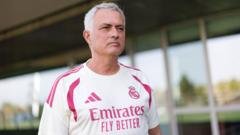
Jose Mourinho left Real Madrid in 2013 as one of the most celebrated managers in world football. Thirteen years later, the self-proclaimed ‘Special One’ is back at the Bernabeu, tasked with restoring a club that has had two successive seasons without a trophy. His return raises an intriguing question: is the 63-year-old still capable of reaching the heights of his past, or has Real Madrid’s president Florentino Perez turned to a manager whose best days are behind him?
Speaking on the More Than The Score podcast, Sport spoke to those who know Mourinho best to assess whether he can make a success of his second spell with Los Blancos. This comes as Mourinho recently revealed he had previously agreed to replace Sir Alex Ferguson at Manchester United, a revelation that surfaced just two days ago. His subsequent spells at Manchester United, Tottenham, Roma, Fenerbahce and Benfica have produced moments of success in cup competitions, but also considerable turbulence.
Mourinho has won only one league title since he left Madrid, the Premier League during his second stint at Chelsea in 2015. Spanish football expert Eduardo Alvarez believes Mourinho’s appointment came about because club president Perez took inspiration from Carlo Ancelotti’s successful second spell at the club. “I think he’s betting on a second stint with Mourinho because Ancelotti was successful during his and it’s a very similar case,” Alvarez said Sport. “Ancelotti was coaching Everton, probably not at the top of his game anymore, 60 years old and suddenly, when he went to Real Madrid again, it worked out and he won the Champions League.”
Alvarez added: “Mourinho falls into the category of Real Madrid not being a manager’s club but being a player’s club. Even if the manager is a big name, the players are the ones who have the power.” This dynamic is highlighted in recent reports, including ‘An iron fist joining a broken team: Inside Mourinho’s Real return’
Former Real Madrid president Ramon Calderon, who led the club from 2006 to 2009, has welcomed the appointment but warned the Portuguese manager. “He’s going to need to change the behaviour and the attitude of the players,” he said Sport. “He showed, when he was at Real 13 years ago, a lot of protagonism. He had many problems with clubs, rivals and even his own players. I think he has to gain the respect and trust of the players by persuasion, not by imposition. He has to show he is a leader, not a dictator.”
After leading Inter Milan to a Serie A, Coppa Italia and Champions League Treble in 2009, Mourinho’s first spell at Madrid was marked by fierce rivalries, dressing-room tensions and a highly volatile relationship with the Spanish media. “I hope he can change,” added Calderon. “If he insists on the same mistakes, it will be a problem.”
That question of whether Mourinho has changed has also been asked in Portugal, where he spent last season. Portuguese football journalist Duarte Monteiro believes the answer is no. He added: “Mourinho didn’t change. His character, his personality didn’t change. The problem, I think, for him is that the young players today, the journalists and the environment is different and I think there’s not as much patience for his methods.”
Monteiro described Benfica’s football last season as “not very sexy”, with Mourinho adopting a conservative approach. There were still highlights, notably a famous 4-2 victory over Real Madrid in the Champions League group stage. But Monteiro said Mourinho’s old personality traits remained evident: “He had two or three public spats with players. Not every player at Benfica was with him last season.”
Former Chelsea defender Robert Huth, who helped Mourinho’s side secure back-to-back Premier League titles in 2005 and 2006, reflected on his former manager’s intensity. “I was impressed but a bit scared as well. When I did interact with him, it was very brutal. Looking back now, it was basically: if you don’t perform, you are out. It was a very high-pressure environment.”
Huth said Mourinho still possessed “unbelievable knowledge” of the game, but now needed to convince the current players at Real Madrid to believe in him completely as those at Porto, Chelsea and Inter Milan once did in their quest for more honours. “What Mourinho did at Porto was a once-in-a-lifetime job,” Huth said. “Now I think he only needs to prove something to himself – and sometimes that’s not good for him.”
At 63, Mourinho has nothing left to prove in terms of reputation, but Real Madrid may demand and need something different than the confrontational style of his past. The club is currently navigating a transition period, with fans and analysts alike questioning if the ‘Special One’ can adapt to the modern dressing room.
As the new season approaches, the pressure on Mourinho to deliver immediate results is immense. With the club having gone two years without a major trophy, the margin for error is slim. Whether his tactical acumen can overcome the potential for internal friction remains the defining narrative of his second Bernabeu chapter.
Published 3 days ago
“The young players today, the journalists and the environment is different and I think there’s not as much openness to embrace him now like maybe there was 20 or 25 years ago, when his character was fresh and new.”
There were still highlights, notably a famous 4-2 victory over Real Madrid in the Champions League group phase before they later lost a play-off tie.
New season, new boss – will Alexander-Arnold be key figure at Real Madrid?
He had many problems with clubs, rivals, referees and was always blaming others for the defeats and not taking the responsibility.
“When you weren’t playing, you knew exactly why you weren’t playing.
“If you had a family problem, or any kind of outside issue that might have an effect on your performance, he was always there for you.
Mourinho’s greatest strength, he believed, was his ability to convince an entire squad to buy into a common cause and mindset.
“He galvanised the squad,” said Huth, who also won the Premier League with Leicester City in 2016.
“When you have someone leading like that, you kind of go, ‘Yeah, I’m in’.
“His training was pure quality, his preparation was amazing, the level of detail he brought to the club, his mentality, the coaches he brought in – they were all on the same page.”
That may be the biggest question Mourinho has to answer, with the Real dressing room containing Kylian Mbappe, Vinicius Jr and Jude Bellingham among a collection of elite players.
Mourinho’s methods have traditionally relied on establishing strong relationships with key personalities and demanding total commitment.
“Bellingham is that kind of guy that gives everything each game.
Managing such stars will prove a defining challenge for Mourinho, said Calderon too.
“The dressing room is full of stars, he has a fantastic squad,” he added.
He took over midway through the 2001-02 season, famously saying he would make them champions the following year.
He delivered, building a team with relatively unknown players but hungry for success.
He won the Portuguese title and Uefa Cup in 2003, then retained the league title and won the Champions League in the following season.
Journalist Monteiro admitted that version of Mourinho was impossible to recreate.
It’s not simply the charisma and tactical intelligence that made him a global managerial icon, but the ability to adapt.
Follow your club with Sport Published 8 June
Listen to the latest Football Daily podcast
Get football news sent straight to your phone Published 8 June
Get football news sent straight to your phone