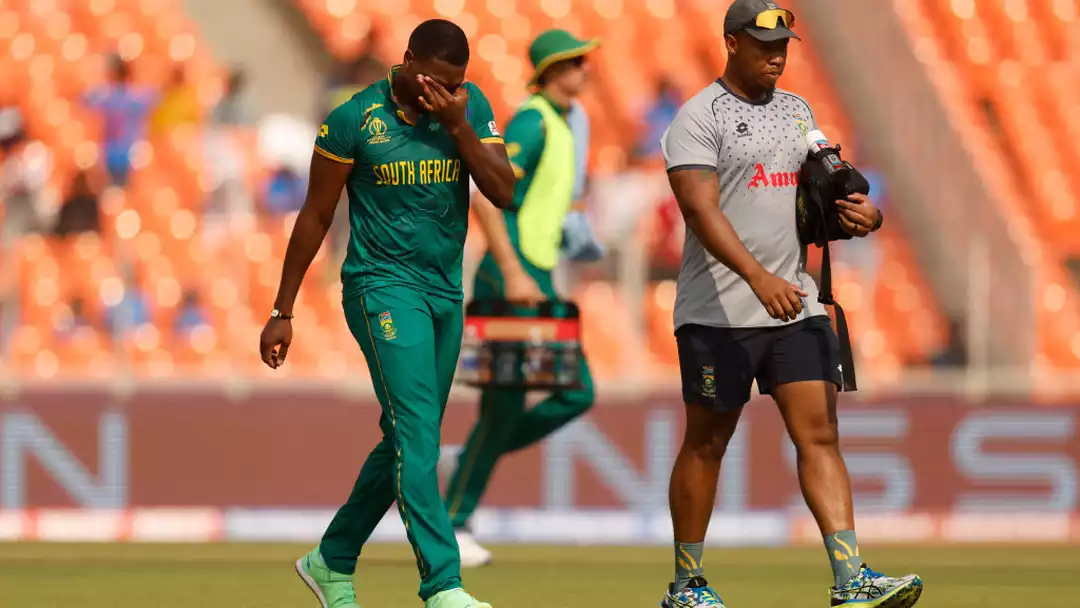
South Africa is currently navigating a significant medical challenge as five of its premier fast bowlers—Kagiso Rabada, Lungi Ngidi, Kwena Maphaka, Ottneil Baartman, and Lutho Sipamla—have sustained hamstring injuries in recent weeks. With the exception of Sipamla, all of these players were originally named in the squad for the ODI series against Australia, which commenced at Kingsmead on Thursday. And will doubtless be back on the tightrope, all five have been caught by the safety net of treatment and rehabilitation.
Dr. Hashendra Ramjee, CSA’s chief medical officer and current doctor for the men’s national team, acknowledges that while a mantra among strength and conditioning experts suggests that “high-speed running is the vaccine for hamstring injuries,” the reality of professional cricket is far more complex. While running is essential for physical conditioning, it remains a common trigger for muscle strain, leaving bowlers to perform on a metaphorical tightrope. Ramjee doesn’t claim ownership of that striking statement. Thing is, running — whether at high speed or at the modest pace of casual 5km trundlers — can also trigger hamstring injuries.
Addressing the cluster of injuries, Dr. Ramjee noted that there is no singular cause for the current situation. The injuries occurred during different stages of preparation: Kagiso Rabada suffered his during preseason conditioning, Lungi Ngidi and Ottneil Baartman broke down during the initial round of domestic first-class matches, and Kwena Maphaka had been working through a rigorous winter program in the high-performance setup.
Shuaib Manjra, the former medical lead for the team, previously identified that hamstring issues frequently spike at the beginning of a season, when workloads increase, and at the end of a season, when muscle fatigue sets in. Dr. Ramjee concurs, emphasizing the risks inherent in the transition between rest phases and high-intensity running phases. These planned transitions often create vulnerable points for players, a factor further compounded by an athlete’s history of prior injuries. “We’re always talking about transition; from the rest phase into the early phase and into the high-speed running phase,” Ramjee said. “Sometimes that transition, even a planned transition, creates the risk.
Fast bowling exerts immense strain on the human body, acting as a high-impact, biomechanically demanding action. The process involves a long run-up followed by a massive stride, culminating in significant ground forces that travel from the feet through the legs and spine. Upon delivery, the body must then execute a complex follow-through to dissipate the momentum, placing a heavy load on the entire musculoskeletal system. Move our thighs and hips backward, and slow down our stride so our feet hit the ground under control, they help us bend at the knees. Without hamstrings we cannot walk or run.
To mitigate these risks, modern cricket now relies heavily on GPS monitoring and individual performance metrics. This technology allows medical staff to identify acute chronic workloads, intervening if a player enters a danger zone. Dr. Ramjee noted that this approach is fully supported by coaching staff, including Shukri Conrad and Piet Botha, who recognize the necessity of these scientific interventions to manage player health.
The team is shifting its philosophy to view the cricket season not as individual series, but as a holistic calendar year. This involves tracking the total number of balls a bowler delivers annually to proactively implement rest, similar to the strategy employed by Australia. Australia has long treated its fast bowlers as highly valuable assets; for example, captain Pat Cummins, 33, is expected to sit out two of the three ODIs in South Africa to ensure his fitness for the Test series beginning October 9. Similarly, Australian pacers Mitchell Starc, 36, and Josh Hazlewood, 35, have been managed with restricted workloads during their recent tour of Zimbabwe and South Africa. In fact, three at the back of each upper thigh.
While the goal is to build resistance and mitigate future injury risks through careful planning and implementation, Dr. Ramjee admits that the process is not always perfect. Success depends on collective buy-in from the support staff and the players themselves, a task that can occasionally be difficult when dealing with the inherent competitive drive of professional fast bowlers.