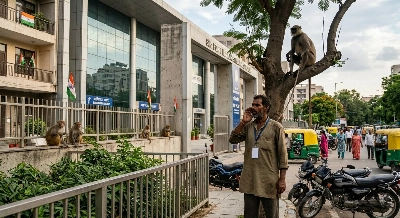
As top-tier badminton athletes descend upon New Delhi for the upcoming world championships, an unconventional security detail has been tasked with protecting the event. While the world watches the stars on the court, a four-member team of “monkey whisperers” is keeping a vigilant watch for rhesus macaques attempting to gatecrash the festivities at the Indira Gandhi Indoor Stadium, which hosts the tournament beginning this Monday.
The venue faces significant pressure to maintain order following a series of incidents during the India Open in January. During that tournament, a monkey was observed in the spectator stands, while bird droppings and debris falling from a nest caused interruptions to play, leading to widespread criticism of the facility’s management. Organizers are determined to prevent a recurrence of these logistical failures.
To address the primate threat, officials have employed “monkey wallahs”—individuals skilled in imitating the vocalizations of langurs, which are the natural predators of the smaller rhesus macaques. Nazar Khan, a 65-year-old member of the team, explained that his family has been involved in this line of work for generations. Initially, their trade involved performing with monkeys and bears, but those practices were eventually prohibited by court rulings that banned the capture and use of such animals.
“We are running this business for generations, starting with street shows of monkeys and bears,” Khan told AFP. “But then it was banned and to keep our pot burning we took to driving away monkeys, and here we are. We kept langurs with us but then they were also banned.” Today, the handlers rely on their deep experience, keen observation, and an array of convincing animal noises to deter the animals without causing them physical harm.
The presence of monkeys remains a persistent issue in the Indian capital, where they are known to raid offices, gardens, and homes, occasionally turning aggressive toward residents. Khan noted that the current group of animals near the stadium includes several individuals that are considered particularly dangerous. “There are three-four monkeys and two fat ones who many say are dangerous,” he stated. “But we make specific noises that drive them away. We know our stuff.”
The scope of the team’s responsibilities extends beyond primates. Khan explained that they are also tasked with managing stray dogs within the stadium complex, ensuring they are removed safely. He noted that his grandson is currently involved in similar work, specifically protecting the office premises of Indian Prime Minister Narendra Modi from monkey incursions. Faryad Ali, Khan’s nephew, demonstrated the effectiveness of their techniques by performing a series of guttural hoots and screeches.
The profession carries inherent risks, including the potential for injury. Ali displayed scars on his torso from past encounters, noting that bites are an occupational hazard. He described their traditional approach to recovery, which involves applying chili powder to wounds rather than seeking medical intervention, allowing them to return to their duties quickly. Despite the physical danger, the team remains committed to their specialized role.
The deployment of these whisperers has drawn some ridicule online, but prominent figures have stepped forward to defend the strategy. Indian badminton star and Olympic medallist P.V. Sindhu took to social media to support the initiative, drawing a parallel to the use of Rufus the hawk at Wimbledon, which is employed to keep pigeons away from the grass courts. “You can laugh at the solution, but you have to love the effort,” Sindhu wrote. “Every major sporting event has its own local challenges. This is just one additional measure on top of the countless measures already being taken.”
Tournament organizers have implemented a comprehensive strategy to ensure the championship proceeds without disruption. Beyond the monkey whisperers, teams have applied a non-toxic gel to roof structures and ventilation ducts to discourage pigeons from nesting or roosting in the stadium. Badminton Association of India secretary Sanjay Mishra expressed confidence in these combined efforts. “I am 100 percent sure that this time the pigeon-related or any kind of bird and animal-related problems will not occur during the world championship,” Mishra stated.
Determined to avoid a repeat of the embarrassment, organisers have turned to a popular fix for the problem — “monkey wallahs” or men who imitate the calls of langurs, the natural enemy of the smaller primates.