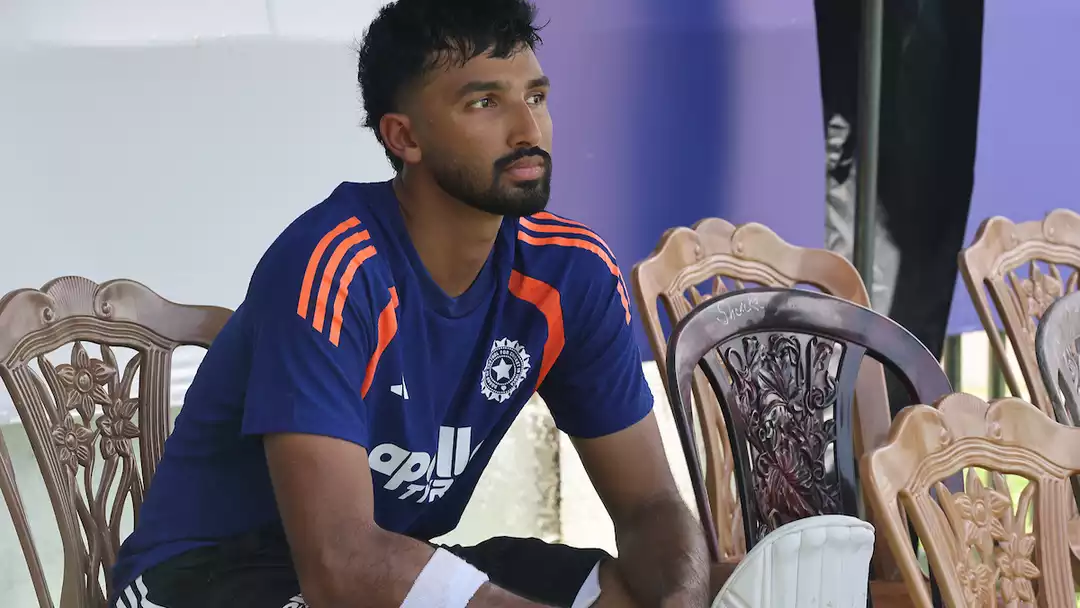
Devdutt Padikkal approached his practice session two days before the match with clear intent. With Sai Sudharsan ruled out due to an injury that failed to improve despite constant medical monitoring, the pivotal No. 3 position became available. Padikkal spent his Thursday training alongside captain Shubman Gill, preparing for what would be his first Test appearance in the subcontinent. His preparation included focused work against off-spinner Saransh Jain, where he utilized his reach effectively, and a confidence-boosting 142-run innings off 164 balls against the Sri Lanka Cricket XI in Colombo just a week prior.
Reflecting on the roster change, Shubman Gill noted that the decision to exclude Sudharsan was made with the player’s long-term health in mind. The team opted against taking risks with his fitness, even though it necessitated calling upon a newcomer to fill a high-pressure role. Following the team’s three-hour training session on Thursday, Padikkal also practiced close-in catching, signaling his readiness to field at short leg if required.
This latest personnel shift highlights India’s persistent instability at the one-drop position, a spot that has remained unsettled since the 2023 World Test Championship (WTC) final. The departure of Cheteshwar Pujara, who held the position for 155 innings over 13 years and accumulated 6,529 runs, left a significant void. Since that final, the team has navigated a period of intense transition, complicated by the retirements and injuries of senior players like Virat Kohli and Rohit Sharma.
The current management’s approach has been characterized by frequent rotation. Sai Sudharsan, for instance, was trusted for the tour opener only to be dropped for the subsequent match due to tactical shifts. Similarly, Karun Nair was given a two-Test window before Sudharsan returned to the lineup. Even in domestic conditions, the lack of a long-term commitment is evident; Sudharsan played against the West Indies in October, but was replaced by all-rounder Washington Sundar against South Africa in Kolkata to provide extra bowling depth—a move that was ultimately abandoned after Gill suffered an injury.
Historically, the No. 3 spot has served as the backbone of successful Test teams. Three of the top ten run-scorers in the history of the format played primarily at this position, a figure that increases to five when looking at the top twenty. India previously benefited from the stability of Rahul Dravid, who scored over 10,000 runs at the position. However, the current strategy of treating the spot as a revolving door risks trapping both the team and the players in a cycle of inconsistent opportunities and returns.
While the rest of the top four—comprising KL Rahul, Yashasvi Jaiswal, and Shubman Gill—appears relatively fixed, the management seems emboldened to experiment with the remaining vacancy. Yet, this stability in the surrounding order could arguably provide the perfect environment to nurture a young batter at No. 3, allowing them to develop while the others shoulder the primary scoring burden.
For the upcoming fortnight in Sri Lanka, Padikkal has the chance to stake his claim. However, the long-term plan remains unclear. With Sudharsan expected to return for the two-Test series against New Zealand in November and the Border-Gavaskar Trophy against Australia looming early next year, India has yet to provide a definitive answer regarding their preferred candidate. Ultimately, the decisions made by Gill and the coaching staff will determine whether a reliable No. 3 can emerge from this ongoing period of churn.
By the time Padikkal was done with his 164-ball 142 on Day 2, the news of his circumstantial promotion from understudy to incumbent would’ve reached him.
So, sometimes you have to take a call from the player’s point of view as to whether you want to take that risk.”
3 amid a period of wild transition.
“It looked like he would be able to be a part of the series.
But we did constant scans and he wasn’t improving as much as we expected him to.
India rightly didn’t take risks, even if it meant another rookie batter at this level had to be thrown in at the deep end.
Padikkal might already be ready for it, even if the numbers don’t quite add up yet.
But this latest reshuffle is another reminder of India’s growing pains at No.
There’s a caveat to the tables above.
It isn’t Gill’s fault that the gametime for No.3 batters are scattered so much.
It’s the state in which he inherited the squad last year in England.
But how he and Gambhir have operated since has added to the intriguing approach.
Maybe in English conditions with a bigger need to improvise, such a call was justified.
But the collateral for such maneuverswas that neither Sai Sudharsan nor Nair could truly own the spot.
Sai Sudharsan’s potential earned him the trust post the tour, but even at home the idea of a long rope remains a myth.
It was a move of convenience, but had to beshelved a game later because of Gill’s injury.
Maybe the ways of modern cricket gives India an excuse to be flexible with a position that has traditionally been a team’s batting fulcrum.Three of the top-10 run-getters in Test history played the majority of their careers at No.
3, while that number rises to five if the list is extended to the top-20.
In Cheteshwar Pujara, they had a worthy successor, who occupied the pressure position for 155 innings across 13 years and returned 6529 runs.
But who follows in the same vein in the current circumstances?
If the decision makers remain aggressive with this perform-or-perish approach to No.